Syringe measurement guide
How to read a U-100 syringe
U-100 means 100 units per millilitre. That definition does not change when the barrel is shorter. A 30-unit syringe still delivers 0.01 mL per unit. It simply cannot hold more than 0.30 mL.
1.0 mL, 100-unit barrel
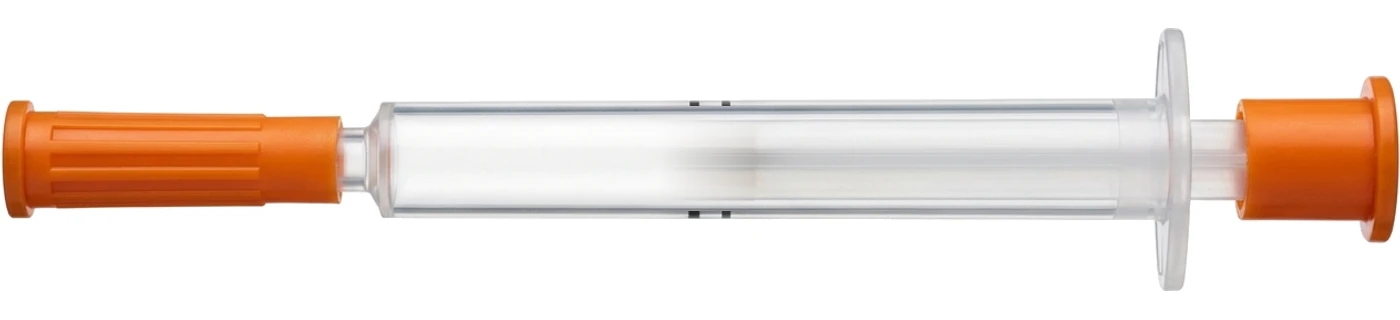
The illustrated plunger sits at 25 units, which is 0.25 mL. At a concentration of 1 mg/mL, 25 units is 0.25 mg (250 mcg). At 10 mg/mL, the same 25 units is 2.5 mg. The barrel records volume. Concentration turns that volume into mass.
0.5 mL, 50-unit barrel
10 units is 0.10 mL on this barrel and on the 100-unit barrel. People ask what 10 units is in mL: it is always 0.10 mL on U-100 insulin syringes.
0.3 mL, 30-unit barrel
The 30-unit barrel is easier to read for small marks such as 5 or 10 units. A target that calculates to 40 units does not fit. Use a 50-unit or 100-unit barrel, or reconstitute in less water so the same peptide mass occupies a smaller volume and the unit mark falls under 30.
How Much Is 0.25 mg, 0.5 mg, or 250 mcg on a 1 mL U-100 Syringe?
0.25 mg and 250 mcg are the same mass. 0.5 mg is 500 mcg. On a 1.0 mL U-100 syringe the mark is that mass divided by the concentration. The peptide calculator applies the same division once the vial mass and the water volume are known.
| Concentration | 250 mcg (0.25 mg) | 0.5 mg (500 mcg) | Volume for 250 mcg |
|---|---|---|---|
| 1 mg/mL | 25 units | 50 units | 0.25 mL |
| 2.5 mg/mL | 10 units | 20 units | 0.10 mL |
| 5 mg/mL | 5 units | 10 units | 0.05 mL |
| 10 mg/mL | 2.5 units | 5 units | 0.025 mL |