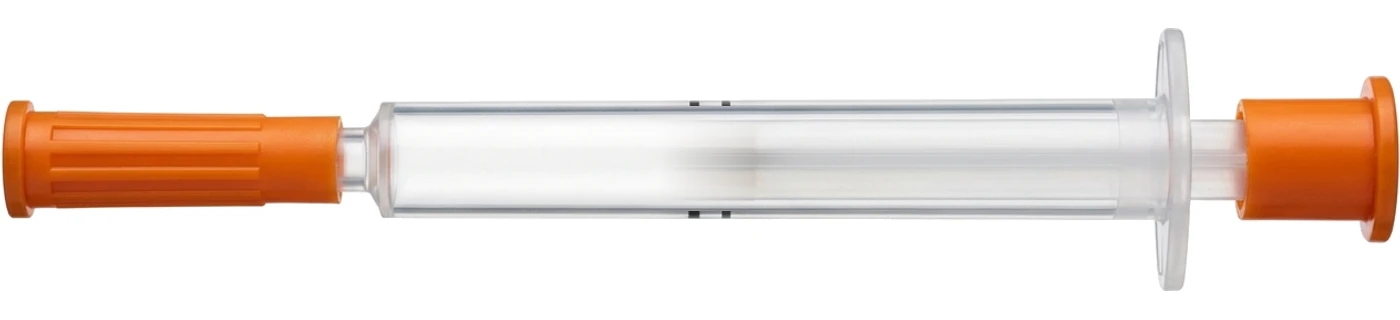
1
Equilibrate the vial to room temperature
Take the lyophilised vial out of the refrigerator and let it sit until the glass is no longer cold. Opening a cold vial pulls moist air inside.
Peptide reconstitution calculator
Volume sets concentration. More water makes each unit weaker and the syringe mark larger. Less water does the opposite. The presets are 1 mL, 2 mL, 3 mL, and 5 mL, and a custom millilitre value is accepted as well.
25 mcg per U-100 unit at this mix.
Duration
Schedule
3 Vials + 1 x 10mL Bacteriostatic Water Needed
View Verified UK Supplier (3 Vials Required) ->Take the lyophilised vial out of the refrigerator and let it sit until the glass is no longer cold. Opening a cold vial pulls moist air inside.
Draw the reconstitution volume for that vial into a sterile syringe. Use bacteriostatic reconstitution solution (0.9% benzyl alcohol) for multi-draw vials.
Aim the liquid down the inside wall of the vial. A direct stream onto the powder drives foam into the solution and makes the meniscus hard to read.
Roll the vial between your palms until the powder has dissolved. Do not shake it. Return the reconstituted vial to a standard UK refrigerator at 2°C–8°C.
Concentration is vial milligrams divided by millilitres. The same 5 mg or 10 mg cake becomes weaker, and the syringe mark for a fixed microgram target becomes larger, as the mixing volume rises.
| Mixing volume | 5 mg vial | 10 mg vial | 250 mcg on the 5 mg vial |
|---|---|---|---|
| 1 mL | 5 mg/mL | 10 mg/mL | 5 units |
| 2 mL | 2.5 mg/mL | 5 mg/mL | 10 units |
| 3 mL | 1.67 mg/mL | 3.33 mg/mL | 15 units |
| 5 mL | 1 mg/mL | 2 mg/mL | 25 units |
IGF-1 LR3 uses 0.6% acetic acid instead of bacteriostatic solution. Other sequences use 0.9% benzyl alcohol bacteriostatic solution for multi-draw vials.